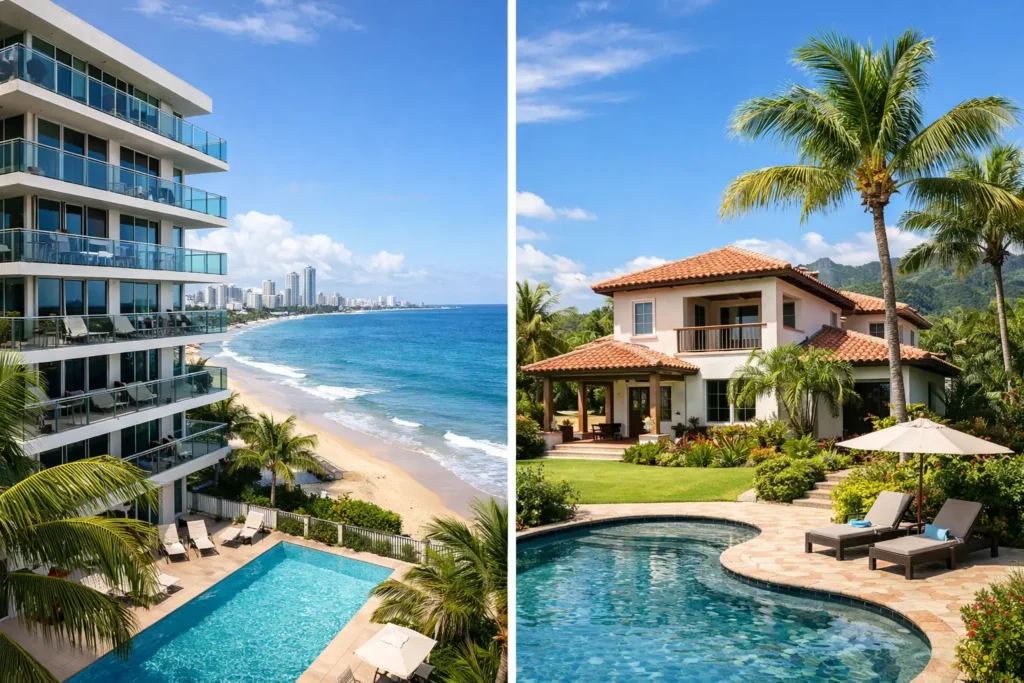
If you are deciding between a condo and a single-family home on the island, the condo vs house Puerto Rico question usually comes down to more than price. It affects how you spend weekends, how much storm prep falls on you, what kind of privacy you get, and how flexible the property will be long term. In Puerto Rico, those trade-offs can feel sharper because location, weather exposure, utilities, and community rules all play a bigger role than many buyers expect.
A buyer looking in Condado, Isla Verde, Dorado, Guaynabo, Río Grande, or Humacao is not just picking square footage. They are choosing a lifestyle, a maintenance burden, and a risk profile. That is why the right answer is rarely universal. It depends on how you plan to live, how often you will be on the island, and how much control you want over the property.
Condo vs house Puerto Rico: the real decision points
The biggest mistake buyers make is treating this like a simple condo-versus-house debate. In Puerto Rico, the property type and the area are tightly linked. Many of the most walkable, amenity-rich coastal locations are condo-heavy. Many of the quieter, more spacious residential pockets lean toward houses or gated single-family communities.
If your priority is convenience, security, and lock-and-leave ownership, a condo often makes sense. If your priority is privacy, outdoor space, and fewer restrictions, a house usually wins. But that is only the starting point.
Condos tend to attract buyers who want easier day-to-day ownership. If you travel often, live off-island part of the year, or want beach access without managing a yard, a condo can be a very efficient fit. In neighborhoods like Condado or Isla Verde, condos can also place you closer to restaurants, hotels, nightlife, and the water.
Houses appeal to buyers who want control. You may want a garage, a private patio, room for kids, pets, or extended family, or simply more distance from neighbors. In places like Guaynabo, Caguas, or certain parts of Dorado and Carolina, houses can offer a more traditional residential experience with space that many condo buildings simply cannot match.
Cost is not just the purchase price
A condo may have a lower entry price than a comparable house in the same area, but monthly ownership costs can tell a different story. HOA dues are a major factor in Puerto Rico condo ownership. Those fees may cover security, common area maintenance, backup systems, building insurance, amenities, and exterior upkeep. In a well-run building, that can be a real advantage. It can also become a meaningful recurring expense.
With a house, you skip the condo association fees in many cases, but you take on more direct responsibility. Landscaping, exterior repairs, roof maintenance, pest control, gate systems, storm shutters, and sometimes private utility-related improvements all fall on you. If the home is in a gated community, you may still have HOA fees, just usually with a different scope than a high-rise condo.
Insurance also deserves a close look. For condos, your building may carry master insurance for common elements, but you still need to understand what your individual policy must cover. For houses, the insurance picture is often broader and can be more expensive depending on location, elevation, construction type, and flood or coastal exposure.
That is why serious buyers should compare true monthly ownership cost, not just list price. Mortgage, HOA, insurance, maintenance, reserve funds, and utilities all matter.
Maintenance in Puerto Rico hits differently
On the mainland, maintenance is already a key difference between condos and houses. In Puerto Rico, it becomes even more important. Salt air, humidity, heavy rain, heat, and storm season create wear that buyers need to plan for from day one.
A condo can reduce your personal maintenance load, especially on exteriors. If you are not local full time, that simplicity has real value. You are not coordinating roof inspections, yard crews, or exterior painting schedules by yourself. In many buildings, management handles a large part of that process.
A house gives you independence, but it also gives you the full list of responsibilities. That includes drainage concerns, exterior sealing, tree trimming, fence repairs, and storm readiness. Some buyers are completely comfortable with that. Others do not realize how much attention a house can require until after closing.
This is where lifestyle matters. If you want to show up, enjoy the property, and leave with minimal effort, condo ownership is often cleaner. If you enjoy managing your property, upgrading it over time, and having full control over the exterior, a house may be the better fit.
Privacy, noise, and flexibility
Privacy is one of the clearest advantages a house can offer. You usually have fewer shared walls, more separation from neighbors, and more freedom over your use of space. That matters if you work from home, have children, host family often, or simply want a quieter environment.
Condos can still work well for many buyers, especially in newer or well-built communities, but shared walls, elevators, parking rules, and common spaces are part of the package. Some buyers love the convenience and energy of condo living. Others find the trade-off too limiting after a few months.
Flexibility is another major dividing line. With a house, you often have more freedom to renovate, expand, add outdoor features, or personalize the property. With a condo, modifications are typically more restricted. The association may control what you can change, when work can be done, and how the property can be used.
That becomes especially relevant for buyers thinking ahead. If this property may evolve from a primary home into a second home, rental, or multigenerational setup, you want to understand those limits before you buy.
Condo vs house Puerto Rico for rentals and second homes
Many Puerto Rico buyers are not choosing only for today. They are also thinking about future use, whether that means seasonal occupancy, long-term rental income, or eventual resale.
For second-home buyers, condos often have the edge on convenience. Security, managed common areas, and easier absentee ownership can make them attractive if you are not on the island year-round. In strong lifestyle markets, that can be a powerful benefit.
For rental investors, the answer depends on the building, the neighborhood, and the rules. Some condo associations limit short-term rentals or impose strict leasing policies. Others are more flexible. A house may offer fewer use restrictions, but operating costs and maintenance can be less predictable. Either way, Puerto Rico buyers should never assume rental use is allowed. It needs to be verified in writing.
For resale, both property types can perform well, but buyer demand differs by market. In urban and beachfront locations, condos may attract strong interest because inventory is naturally concentrated there. In suburban family-oriented markets, houses may have broader appeal. The best move is not asking which property type is always better. It is asking which one is better for that neighborhood and buyer pool.
Location changes the answer
A condo in Condado is not competing with a house in Caguas in any meaningful way. They serve different buyers and different lifestyles. Even within the same municipality, the right choice can shift quickly.
In San Juan and other dense coastal pockets, condos may offer the best combination of access, views, and convenience. In Guaynabo or interior residential areas, a house may deliver more value in space and day-to-day livability. In resort-style markets like Dorado or Río Grande, both options can be compelling, but the decision often comes down to whether you want turnkey ownership or a more private residential setup.
This is why local guidance matters. The most useful comparison is not abstract. It is side-by-side within your budget, your target area, and your intended use.
How to decide with confidence
If you are stuck between the two, start by answering three practical questions. First, how often will you actually be at the property? Second, how much maintenance responsibility do you want? Third, how important is privacy versus convenience?
If you will be off-island often, want simpler ownership, and value amenities or walkability, a condo may be the stronger fit. If you want outdoor space, fewer rules, and more control over how the property functions, a house is usually the better match.
Then pressure-test the numbers. Review HOA dues, insurance, reserve needs, and likely maintenance costs. Ask about building management, power backup, water systems, parking, and rental restrictions. For houses, look closely at lot drainage, exterior condition, and the realistic cost of ongoing upkeep.
A smart purchase in Puerto Rico is rarely about buying the most property. It is about buying the right level of responsibility for the way you live. That is where experienced guidance can save time and prevent expensive surprises. At Homes of Puerto Rico, that means helping buyers compare not just listings, but the ownership experience behind them.
The best property is the one that still fits your life after the excitement of the showing wears off.